Psyllium Husk: Water-Holding and Fullness Effects
Physiological observations of high-capacity water-absorbing soluble fibres and their mechanisms of satiety action.
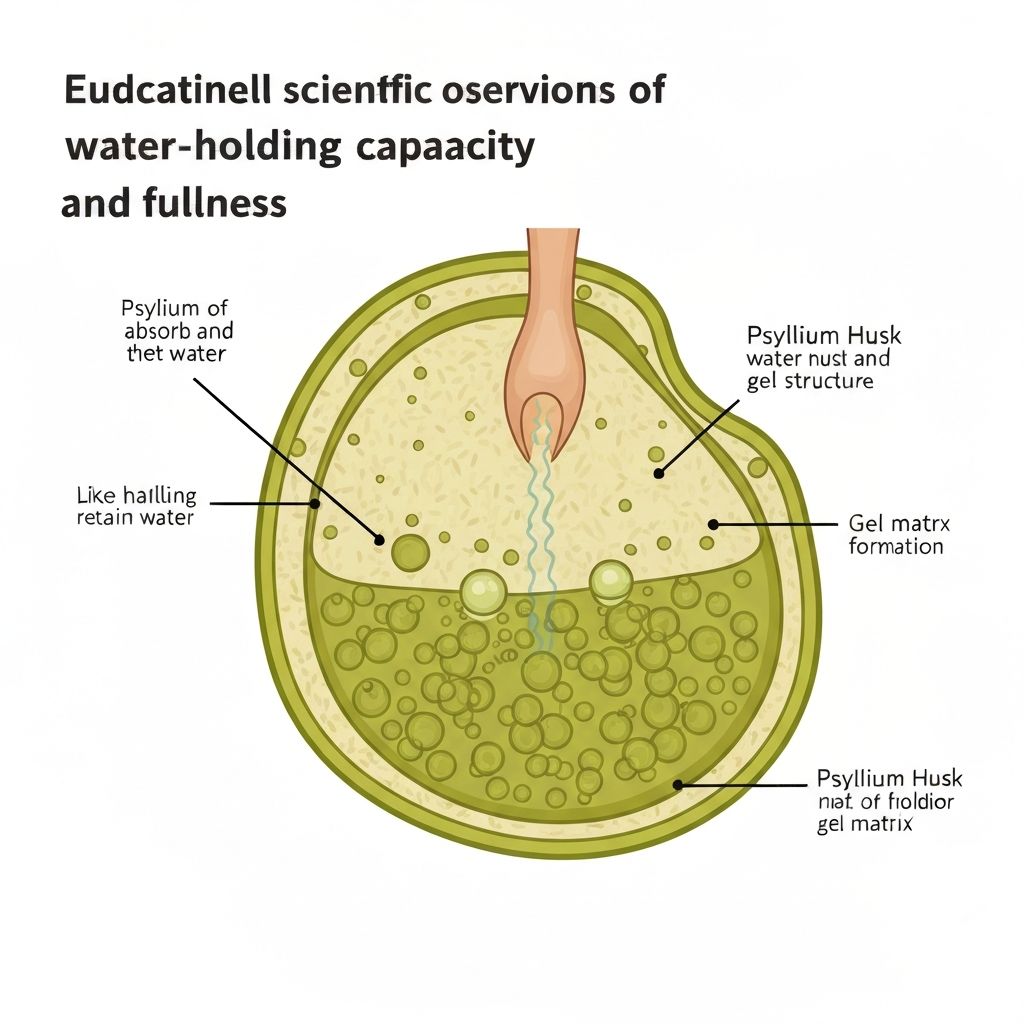
Chemical Composition and Water-Holding Capacity
Psyllium husk (Plantago ovata seed coat) is a soluble polysaccharide composed primarily of arabinose, xylose, and galacturonic acid. Its unique structural properties confer extraordinary water-holding capacity—approximately 40–50 grams of water per gram of dry psyllium fibre, substantially exceeding most other soluble fibres.
Comparative Water-Holding Capacities
| Fibre Source | Type | Water-Holding Capacity (g water per g fibre) | Gel Formation Speed |
|---|---|---|---|
| Psyllium husk | Soluble | 40–50 | Rapid (5–10 minutes in aqueous environment) |
| Beta-glucan (oats) | Soluble | 100–120 | Moderate (15–20 minutes) |
| Guar gum | Soluble | 50–80 | Moderate-to-rapid (10–15 minutes) |
| Cellulose | Insoluble | 8–10 | Non-dissolutive; mechanical effect |
The rapid gel-formation kinetics of psyllium make it particularly effective at producing immediate gastric distension. A single 10 g dose of psyllium can absorb 400–500 mL of water, dramatically increasing gastric volume.
Satiety Mechanisms: Mechanical Distension vs. Nutrient Sensing
Psyllium produces satiety through two primary mechanisms, which operate independently and synergistically:
Gastric Distension (Immediate, Mechanical)
Rapid gel formation increases stomach volume, activating mechanoreceptors in the gastric wall within 10–30 minutes of consumption. This distension-mediated signal is nutrient-independent—satiety occurs through pure volume expansion, not nutrient absorption or chemoreceptor sensing. Vagal afferent signalling from gastric stretch receptors to the nucleus tractus solitarius (NTS) generates satiety sensation.
The magnitude of satiety is proportional to gastric volume: 10 g psyllium → ~500 mL volume → strong satiety signal. Higher doses (15–20 g) produce proportionally stronger gastric distension but may cause uncomfortable bloating.
Intestinal Bulking (Delayed, Mechanical)
As psyllium-water gel enters the small intestine and colon, continued water absorption increases faecal bulk. Large intestinal distension activates colonic mechanoreceptors, producing additional satiety signals 2–4 hours post-ingestion. This "delayed" component extends satiety duration beyond the immediate gastric effect.
Absence of Nutrient-Sensing Component
Unlike soluble fibres that slow nutrient absorption (thereby prolonging chemoreceptor signalling), psyllium is minimally fermented and does not produce significant SCFA. Consequently, psyllium-induced satiety does not benefit from hormonal signalling mechanisms (CCK, GLP-1, PYY) as much as other fibres. Satiety is primarily mechanoreceptor-mediated.
Clinical Evidence for Satiety and Energy Intake Reduction
Randomised controlled trials have quantified psyllium's satiety effects:
Visual Analogue Scale (VAS) Studies
- Acute satiety: 10 g psyllium reduces hunger ratings by 25–40% and increases fullness ratings by 20–35% for 2–3 hours post-ingestion
- Onset: Satiety appears rapidly (15–30 minutes), reflecting gastric distension, and plateaus by 60–90 minutes
- Duration: Fullness sensation persists for 2–4 hours as the gel progressively transits to the colon
- Dose-response: 5 g produces modest effects; 10 g produces strong effects; 15 g offers only marginal additional benefit
Ad Libitum Energy Intake
| Study Design | Psyllium Dose | Next-Meal Energy Intake Reduction | Time to Next Meal |
|---|---|---|---|
| Acute, administered as preload | 10 g | 8–18% reduction | 30–60 minutes |
| Acute, added to meal | 5–10 g | 5–15% reduction | 2–4 hours |
| Chronic (4–6 weeks) | 5–10 g / day | 3–8% reduction (may diminish with time) | Variable |
Comparison with Other Satiety Fibres
Psyllium exhibits a distinct satiety profile compared to other viscous soluble fibres:
vs. Beta-Glucan (Oats)
- Onset speed: Psyllium acts more rapidly (15–30 min) due to faster gel formation
- Nutritional sensing: Oat beta-glucan slows nutrient absorption, triggering CCK and GLP-1; psyllium does not
- Total satiety duration: Beta-glucan produces longer-sustained satiety via dual mechanisms; psyllium primarily mechanical
- Tolerance: Psyllium may produce rapid adaptation; beta-glucan effects may be more sustainable
vs. Pectin
- Fermentability: Pectin is readily fermented (producing SCFA); psyllium is slowly fermented
- Satiety profile: Psyllium dominates via mechanical distension; pectin combines mechanical and fermentation-mediated effects
- Individual response: Psyllium satiety is more uniform across individuals; pectin response depends on microbiota composition
vs. Guar Gum
- Viscosity: Both produce strong viscosity; guar gum may be slightly more viscous in equivalent weight
- Practical acceptability: Psyllium is easier to incorporate into beverages (thicker, less slimy texture); guar gum can produce an unpleasant mouthfeel
- Gastrointestinal tolerance: Both are generally well-tolerated; guar gum may cause more gas in sensitive individuals
Dose-Response and Practical Considerations
Psyllium satiety effects exhibit clear dose-dependency:
- 5 g: Modest satiety effect (~30–40% of maximal response); may be tolerated with minimal gastrointestinal symptoms
- 10 g: Strong satiety effect (~80–90% of maximal response); optimal balance between efficacy and tolerability
- 15 g: Marginal additional satiety benefit (~95% of maximal); gastrointestinal symptoms (bloating, flatulence) emerge in many individuals
- 20+ g: Minimal additional benefit; significant discomfort risk; may impede nutrient absorption if consumed with meals
The practical "sweet spot" is 10 g per serving, administered as a preload (15–30 minutes before eating) with substantial water intake (300–500 mL). This maximises gastric distension and satiety while maintaining gastrointestinal comfort.
Administration and Gastrointestinal Effects
The physical properties of psyllium necessitate specific consumption protocols:
Water Requirements
Psyllium requires substantial liquid intake—at least 250 mL per 5 g fibre, preferably 300–500 mL. Insufficient liquid can result in gel formation in the oesophagus or upper stomach without full hydration, creating an unpleasant sensation. Moreover, inadequate hydration reduces the volume of the resulting gel, attenuating satiety effects.
Timing and Meal Composition
Psyllium administered 15–30 minutes before a meal (as a preload) produces stronger satiety effects and greater energy intake reduction than psyllium added to a meal. This reflects the enhanced gastric distension before the stomach is already partially full. However, preload administration may reduce tolerability if the subsequent meal is large.
Gastrointestinal Tolerability
- Flatulence and bloating occur in 10–25% of individuals, likely from colonic bacterial fermentation of unabsorbed psyllium oligosaccharides
- Gradual introduction (starting with 5 g, increasing to 10 g over 1–2 weeks) reduces symptom incidence
- Individuals with slow colonic transit or irritable bowel syndrome may experience exacerbation of symptoms
Chronic Use and Adaptation
Prolonged psyllium consumption produces variable long-term outcomes:
- Satiety adaptation: Subjective fullness sensation may attenuate over 4–8 weeks as the gastrointestinal tract habituates to chronic distension
- Microbiota shifts: Colonic bacteria may increase fermentation capacity, producing more SCFA and potentially sustaining satiety through secondary hormonal mechanisms
- Colonic compliance: Repeated distension may increase colon compliance (receptive relaxation), reducing mechanoreceptor activation per unit volume
- Energy intake changes: Short-term energy reduction (4–6 weeks) often diminishes during longer-term use (12+ weeks), suggesting adaptation dominates
Key Takeaways
Psyllium husk is distinguished by its exceptionally high water-holding capacity and rapid gel formation, producing immediate (15–30 minute onset) and mechanically-mediated satiety. Unlike other soluble fibres, psyllium satiety is nutrient-independent and does not rely on delayed nutrient absorption or fermentation-mediated hormone secretion. Clinical evidence supports 5–15% energy intake reduction per 10 g dose. Satiety effects are more uniform across individuals compared to fibres dependent on microbiota fermentation. However, chronic adaptation may attenuate subjective satiety, and gastrointestinal symptoms (bloating, flatulence) limit long-term tolerability in some individuals. Psyllium is particularly useful for acute satiety augmentation and represents a mechanistically distinct category within the soluble fibre spectrum.